Explain the Political Situation That Brought Reconstruction to an End.
In 1865 following the Civil War southern state legislatures began enacting Black Codes to restrict freedmens rights and maintain the plantation system. Reconstruction 18651877 By the end of the Civil War the South was in a state of political upheaval social disorder and economic decay.
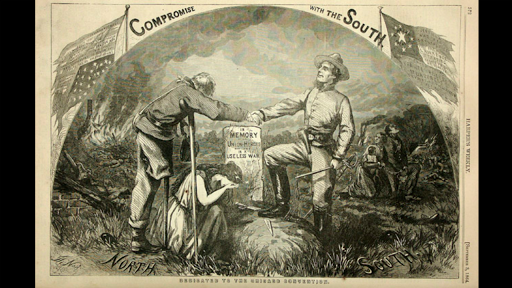
The Compromise Of 1877 Article Khan Academy
This rebuilding was social political and economic.

. Clements the Supreme Court of Georgia ruled two-to-one that Blacks did indeed have a constitutional right to hold office in Georgia. During the 1870s many Republicans retreated from both the racial egalitarianism and the broad definition of federal power spawned by the Civil War. This is the currently selected item.
Up to 24 cash back The goal of this assignment was to discuss the economic political and social issues facing the United States the former Confederate States in particular after the Civil War in a time period known as the Reconstruction Era. Occupying forces led by General Douglas A. Brown appointed by Bullock in July 1868.
18 July 2011 Pre and Post Reconstruction Period Politics Economic and Social Effects This research paper is intended to explain in general terms some of the political economics and social effects America dealt with. With time though this position weakened and African Americans both free Northerners and escaped Southerners were. Traditionally portrayed by historians as a sordid time when vindictive Radical Republicans fastened black supremacy upon the defeated Confederacy Reconstruction has lately been viewed more sympathetically as a laudable experiment in.
The economic issue was the devastation of the Souths economy. The law broke the South into military districts under the command of the army and declared the existing governments to be provisional. Republicans because of government cor-.
Congress brought the course of Throckmorton the legislature and Presidential Reconstruction to an end on March 2 1867 with its First Reconstruction Act. Reconstruction and Repression 1865-1900. The Democrats wanted to end Reconstruction and the Republicans wanted to win the presidency.
The Compromise of 1877. The Republican-controlled Congress responded to these measures by passing the three great postwar constitutional amendments Thirteenth Fourteenth and. The enfranchisement of African American men.
People are perhaps most familiar with the political history of Reconstruction the drama of an epic conflict between President Andrew Johnson and a Republican-dominated Congress. The shift of political power in the South was only one cause of the end of Radical Reconstruction. Freedom and Upheaval When war broke out in 1861 African Americans were ready.
MacArthur enacted widespread military political economic and social reforms. The protest began after the arrest of Rosa Parks a seamstress and a member of the NAACP who defied local ordinances in December 1955 by refusing to yield her seat on the bus to a white man and move to the rear of the vehicle. By the time of the 1876 presidential election Reconstruction had come to an end in most southern states.
Ironically one of the two deciding justices was Chief Justice Joseph E. While very little fighting occurred on Iowa soil and Iowa had never legalized slavery black. The basic political situation that brought Reconstruction to an end was that the Republicans and the Democrats came to a stalemate in the election of 1876.
Color Transparencies Voting Patterns During Reconstruction Answers Reading Skill Hayes proposed to end Reconstruction. The End of Congressional Reconstruction 1869-1871. Its main focus was on bringing the southern states back into full political participation in the Union guaranteeing rights to former slaves and defining new relationships between African Americans and whites.
Texas was placed in the Fifth Military District. And the ratification of three new constitutional amendments that reshaped American jurisprudence in the 20 th century. Hayes the presidency in exchange for the end of Reconstruction in the South.
Nonetheless Reconstruction soon began to wane. Occupation and Reconstruction of Japan 194552 After the defeat of Japan in World War II the United States led the Allies in the occupation and rehabilitation of the Japanese state. Examine the events and forces that brought a weakening of the northern commitment to Reconstruction and an end to the Reconstruction era.
The Unions tactics of total war destroyed southern crops plantations and entire cities and hundreds of thousands of emancipated slaves rushed to Union lines as their masters fled the oncoming Union army. Reconstruction 1865-1877 the period that followed the American Civil War is perhaps the most controversial era in American history. 89 The year-longand ultimately successfulboycott forged the SCLC brought national attention to the struggle and launched King to the forefront of a.
History 2301-SA01 United States History to 1877 Instructor. Between 1945 and 1952 the US. The end of Reconstruction.
Political problems included the re-entry of the formerly rebellious states. End to military rule in the South. The Reconstruction Era lasted from the end of the Civil War in 1865 to 1877.
Pre and Post Reconstruction Period Politics Economic and Social Effects 2107 Words 9 Pages. Free African Americans flocked to join the Union army but were rejected at first for fear of alienating pro-slavery sympathizers in the North and the Border States. Grant used the Act to challenge Klan activity which was most prevalent in South Carolina.
THEMATIC GUIDE Reconstruction refers to the process by which the nation was rebuilt after the destruction caused by the Civil War. Fewer rights for African Americans. In June 1869 in White v.
Southern corruption and instability Reconstructions critics argued stemmed from the exclusion of the regions best menthe plantersfrom power. White supremacists gradually reasserted control over the South as. In Congress the political power of the Radical Republicans had waned although some continued their efforts to realize the dream of equality between blacks and whites.
History the period 186577 that followed the American Civil War and during which attempts were made to redress the inequities of slavery and its political social and economic legacy and to solve the problems arising from the readmission to the Union of the 11 states that had seceded at or before the outbreak of war. The other key factor was a series of sweeping Supreme Court rulings in the 1870 s and 1880 s that weakened radical policy in the years before. Yet as Reconstruction came to a close so did counter-Klan measures.
The Compromise of 1877 gave Rutherford B.

Reconstruction A Timeline Of The Post Civil War Era History
Reconstruction A Timeline Of The Post Civil War Era History
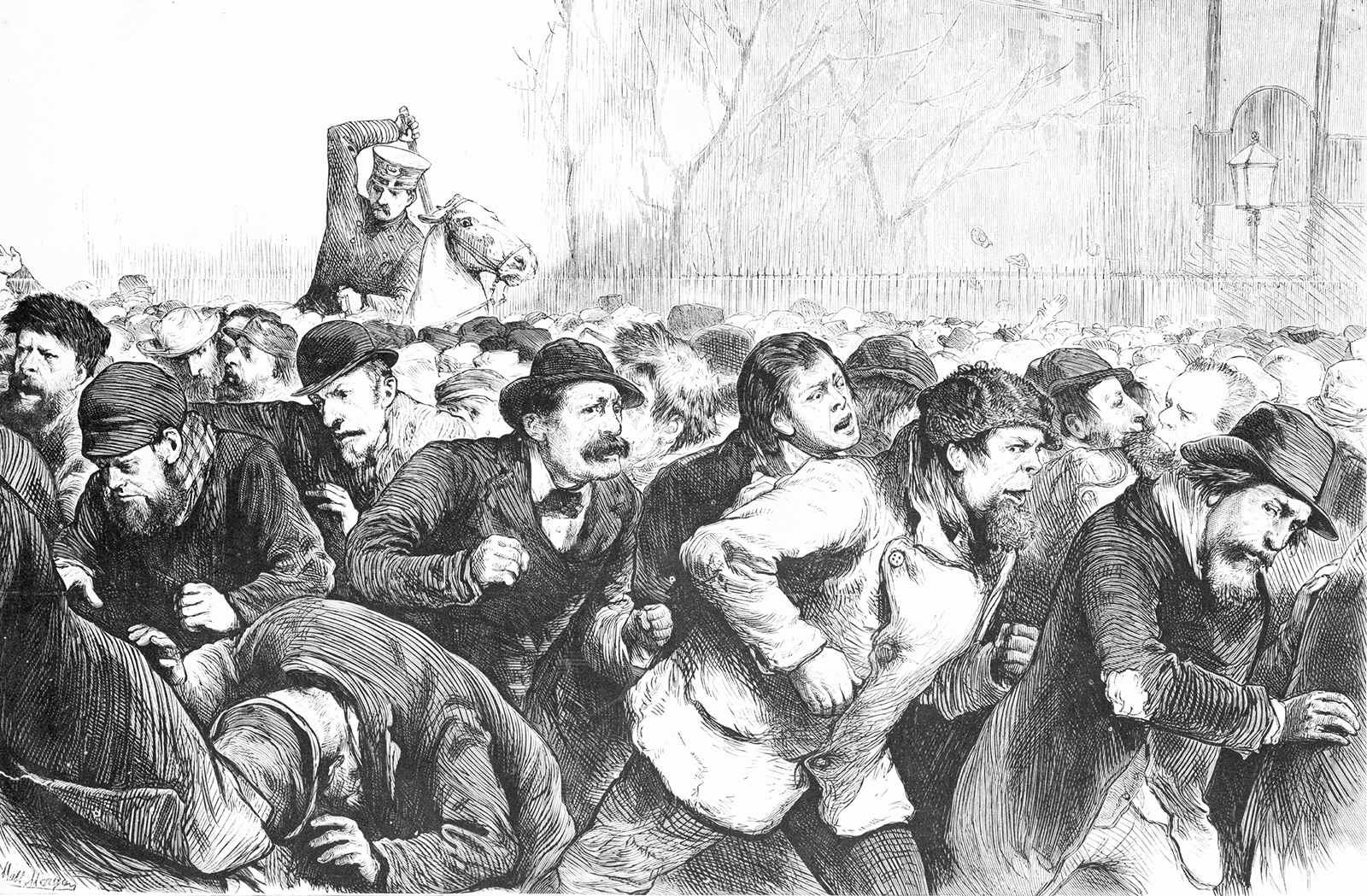
The End Of Reconstruction Us History I Ay Collection


Comments
Post a Comment